Key takeaways
- Posts and footings decide whether a fence stays straight.
- Posts are set below the frost line and in concrete or compacted gravel.
- Rails tie the posts together and carry the boards or panels.
- Gates are the hardest-working part and need stronger posts and bracing.
Posts and footings
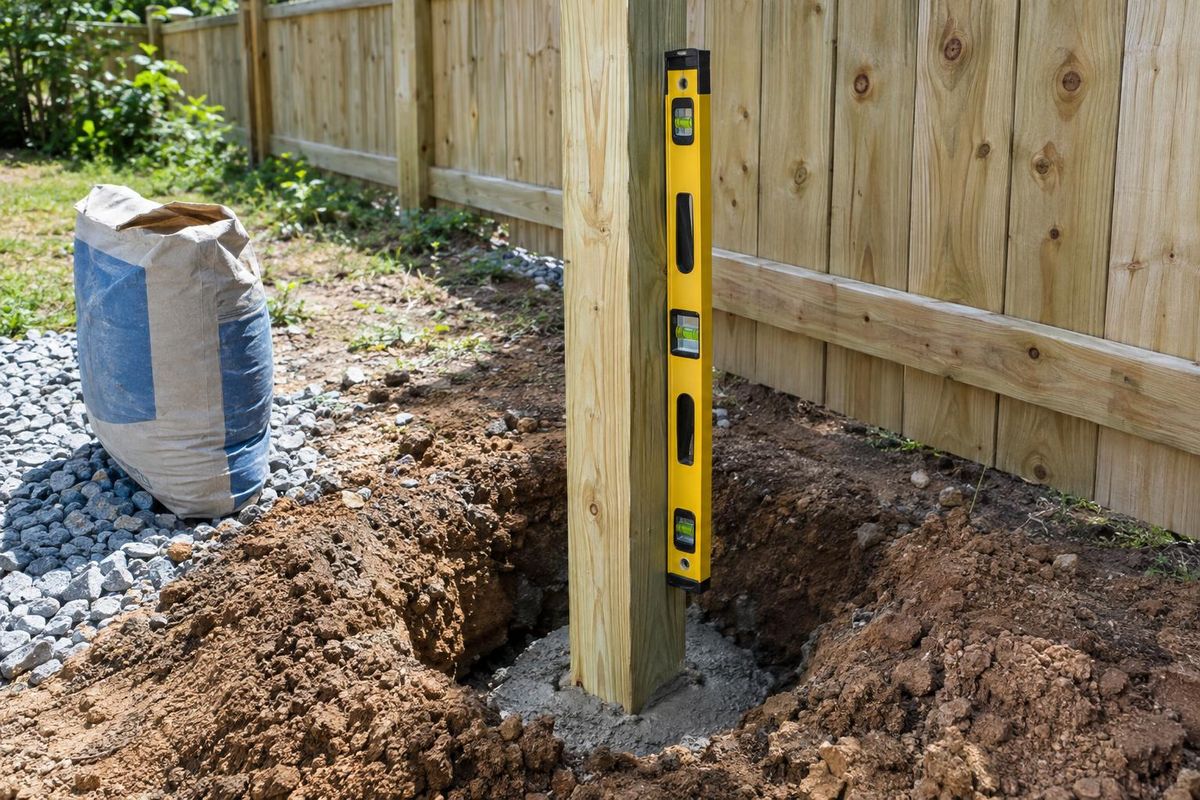
Posts carry the fence. In Middle Tennessee they are usually set at least a third of their length in the ground and below the frost line, in concrete or well-compacted gravel, and spaced six to eight feet apart for wood and vinyl.
Posts fail first, either by rotting at the ground line or by shifting in soft ground. That is why a sturdy post is the most important part of a long-lasting fence.
Rails and panels
Rails run between posts and hold the boards, pickets or panels. A six-foot privacy fence usually has three rails, and heavier styles add more. Boards are fastened with exterior screws or ring-shank nails.
Metal and vinyl fences use factory panels or rails that fit posts made for the system. Wire fences are stretched between braced end posts.
Corners, ends and gates
Corners and ends carry the pull of the fence line, so they get extra bracing. Gates add moving loads, which is why gate posts are bigger and set deeper.
A diagonal brace across a wood gate frame keeps it from sagging as it ages.
Where fences fail
The usual causes are posts set too shallow, no concrete, wood in constant contact with wet soil, fasteners that rust and gates that are too heavy for the posts. Poor drainage, trees and sloping ground add stress.
A fence built with these in mind lasts much longer than one that is only built to look good on the first day.
Quick answers
How deep should fence posts be?
A third of the post length and below the frost line is a common rule of thumb.
Why use concrete?
It holds the post firmly and keeps it from shifting in soft ground.
Do I need to call 811 first?
Yes. Utilities must be marked before digging.